
Solitary Confinement

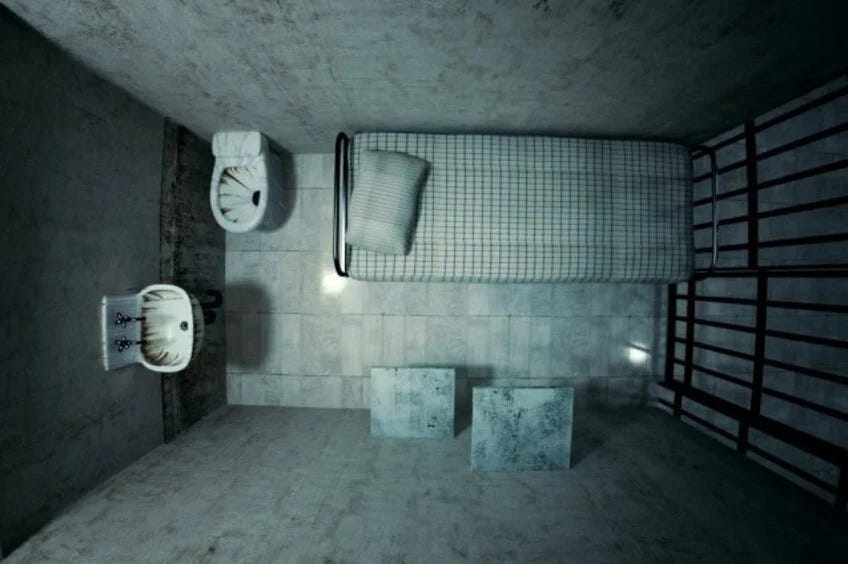
I can no longer recall how many times I’ve been placed into solitary confinement, as all occurrences fell within a window of less than a year and over a quarter of a century ago. But you’d need at least two hands to complete the tally.
I’m not overly familiar with how it works in the civilian world, but at that time in the military, and depending on the circumstances surrounding your arrest, they’d place you in a solitary cell for a day or two. There were no “drunk tanks,” if you will. Separately, if or when you received a jail sentence, you were first placed into solitary confinement for around a week, give or take, based on the observations and discretion of the staff. The purpose was to integrate you into your new surroundings before being released into the general population. After that, it becomes “as needed” for a variety of transgressions.
The first time I was arrested and put in a jail cell was when I was finally, almost mercifully caught forging my own prescriptions for opiates on the hospital computer system at Nellis Air Force Base. I was placed in a solitary cell for at least two days. Though again, so much time has passed, I honestly don’t recall for exactly how long. Another factor clouding the memory of that particular incident could be that I was experiencing debilitating withdrawals for the first time, which I didn’t even know was a thing.
Over the next handful of months, while investigations were being conducted and I was awaiting trial, I would forge prescriptions all over Las Vegas, eventually get caught, get thrown back in solitary for a day or two, get a little dope sick, get released, then start the process over. Until perhaps the last few weeks before the trial.
By the time my trial began, I had managed to stay clean long enough to forgo getting sick upon being jailed again. But I was languishing in the knowledge that I was about to spend the next week or so in one of the two solitary confinement cells I had come to know well, before joining the rest of the inmates to serve out my sentence. On day two of the trial, I was convicted of multiple felonies and given one year in prison.
I then spent six consecutive days in solitary confinement. I don’t know what it’s like now, but 25 years ago, the fluorescent lights were always on, and there were no windows. So there was no natural light, but no darkness either. You were not allowed to lie or sit on your bunk until after “work hours.” There was a metal chair to sit on, or you stood. You left your cell only to shower. This also meant no outside time, and no options for exercise were provided. No books were allowed, and the same went for a pencil and paper. On the other side of the bars, there was a clock on the wall that felt mostly like a cruel joke. Gen pop was heaven after that.
Months later, due to the length of my sentence, I was transferred to the larger Edwards Air Force Base jail, where I was promptly informed that I was about to spend six more days in solitary confinement. Once again, so I could integrate into my new surroundings.
I understood that I was at a new facility, but I felt pretty damn well integrated already. And just the thought of going through another stretch of such torment dropped my chin and slouched my shoulders in a way that nothing else has managed to do before or since. The same protocols were in place at Edwards, though my cell there had a sliver of a window. Which I was initially thankful to have, but in some ways made the situation more excruciating.
I consider those two six-day stints to have been more difficult than any of the shorter stays, despite withdrawals. The duration is a large factor, but also because physical discomfort was replaced by mental anguish. And while the discomfort got incrementally better with time, the anguish grew worse expeditiously.
With that much worthless, wasted, and yet somehow taxing time to kill, my mind became ill at ease and would occasionally wander off into some especially dark places. And at times, it would take the soul with it for company, leaving the body to fecklessly fend for itself. After a few days, I began to feel like there must be a tipping point where the three might start to falter or begin infighting.
A fellow writer and good friend of mine once spent four days in a dark cave retreat for a magazine story. I remember discussing it with him, thinking, based on my own encounters, how in the world could anybody voluntarily sign up for four days in darkness with no external stimulus?
I detailed to him my history with holding cells, and he told me something that I have churned on many times since. He reasoned that the two longer instances were so agonizing because I had just enough stimulus to feel the emotional and physical confinement. Enough stimulus to know that I wasn’t getting enough. With few exceptions, in those scenarios time exists in a state of endless tedium with no minute differentiating itself from the previous or the next.
But in the absence of stimulus, the mind wanders, explores, fills in gaps, creates its own timeline, and to some degree, engages itself. When you literally can’t even stare at a blank wall, you somehow destroy boredom’s habitat, and it can no longer exist. That blew my mind with just how much sense it made. I was recently able to experience something similar on a microscale, and it proved to be true. Now, after all of these endeavors and more, the phrase, “Time is a construct,” finally holds personal and real meaning.
I’m not educated in any way with regard to this form of confinement, or any other, for that matter. But I’ve certainly endured my share of invitation-only events. I understand and am receptive to the arguments that it does have its place and purpose. I also recognize that the withdrawals I suffered were on me, and not a part of the typical set of environmental factors to be expected.
However, those two six-day sessions were pretty standard. I consider myself to be a rather resilient individual, but on each occasion, I felt the cracks beginning to form within me after less than a full week. I can’t conceive the sort of psychological unraveling that anyone subjected to it for an even more extended period of time would ultimately succumb to. Personally, I find it difficult to imagine that solitary confinement, even under the best of conditions, doesn’t have at least one foot slightly beyond corrective punishment, and over the line into torture.
The way you shared this brought me alongside you and into a space I don’t have personal reference for, yet found myself reflecting deeply on. Thank you for speaking so openly.
This may be a construct of my own, but I swear I've read something you wrote about isolation tanks. If this was you, do you think that anything in your previous experiences in solitary confinement lead you to try the iso tank? Or was that something altogether different? BTW, I was also in the USAF, from 1985-1989, and also in So. Cal., Mojave Desert region. I used to long for the freedoms of the civilians I worked with.